Nearsightedness, myopia
Symptoms and causes of myopia
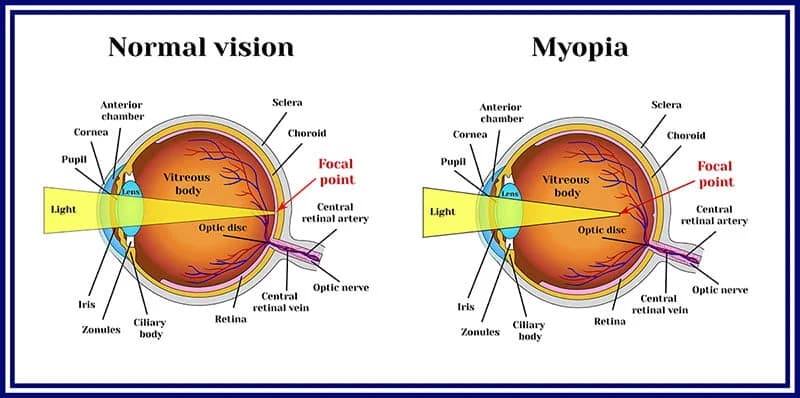
If you are nearsighted, distant objects appear blurry. Squinting can make these objects appear clearer. For example, nearsighted students can read books and see classmates nearby, but the teacher and the board look blurred. Myopia (also known as nearsightedness) develops when light rays entering the eye are refracted too strongly and are focused at a point in front of the retina. Eyes with myopia may also be longer than normal or have an overly curved cornea, causing images not to focus on the retina.
When you are nearsighted, images are focused not at the back of the eye but in front of the retina. Myopia usually develops in childhood and is first detected when parents learn that a child cannot read text written on the board at school. Myopia worsens during adolescence and stabilizes in early adulthood. Some experts believe that myopia is hereditary. It may develop with or without astigmatism. A typical indication of myopia in an eyeglass prescription is a minus sign before the first number.
Treatment options for myopia
Correction of myopia depends on various factors, such as age, activities, and profession, but it is usually corrected with contact lenses or glasses. They improve vision without changing the anatomy of the eye, so once they are removed, poor vision immediately returns. See the “Eye examination” section for more information on how to obtain a prescription for corrective glasses or contact lenses, and the “Eye exercises” section to learn how to avoid vision problems by performing eye-strengthening exercises. If you are ready to give up corrective glasses or contact lenses, explore the following vision correction options:
Laser Vision Correction
Although glasses and contact lenses help manage myopia, they can be compared to a cast or crutches — temporary solutions that help you cope but do not address the root cause, which can be corrected surgically.
LASIK vision correction
LASIK (laser-assisted in situ keratomileusis) is the most commonly performed form of laser eye surgery since 1991, when clinical trials were conducted in the United States. During the procedure, the shape of the cornea is altered, eliminating or reducing the need to wear glasses or contact lenses. It is a surgical procedure that involves certain risks.
Laser vision correction – “iQ-LASIK”
LASIK can help reduce the need to wear glasses or contact lenses, and the “iQ-LASIK” method combines the most advanced modern surgical technologies into a single procedure. The result is a more functional and effective laser vision correction surgery. In the past, the same basic LASIK procedure was performed for every patient, regardless of the unique characteristics of the patient’s eyes. The “iQ-LASIK” method is different. Only “iQ-LASIK” enables surgeons to create a treatment plan with individualized options, taking your visual needs into account to ensure the best possible visual outcomes. Your eyes deserve special care. Visit our professional ophthalmologists for a personalized consultation so that we can determine which treatment is best suited for you.
learn moreIntraocular Correction
Intraocular lenses are designed to correct a high degree of astigmatism. If laser correction is not suitable for you, don’t worry — there are other ways to achieve the desired result. The 'British Ophthalmological Center' offers several surgical options that can help you. During a consultation, we can determine whether surgery is contraindicated for you and choose the best procedure option.
learn moreappointment booking
Convenient booking and transparent consultation cost
We have made the process of contacting the clinic as simple as possible. You only need to book an appointment with an ophthalmologist in Vilnius online or by phone.
book a consultation
“*” required fields