Farsightedness
Symptoms and causes of farsightedness
Farsightedness, or hypermetropia, is an accommodation disorder in which the ability to see objects clearly at close distances is reduced. Farsightedness most commonly occurs in older people.
If you are farsighted, objects that are close appear more blurred than those that are far away. For example, if you were sitting on a restaurant’s summer terrace, the menu would look blurry, while the surrounding landscape would appear in focus. However, it is a misconception that farsighted people always see well at a distance. Severe cases of farsightedness can also affect the vision of distant objects.
Farsightedness develops when the cornea is too flat or the eye is too short. These conditions prevent light rays entering the eye from bending properly and focusing on the retina. Instead, images are focused behind the retina.
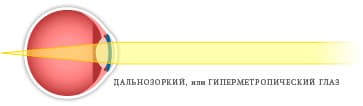
If you are farsighted, images are focused behind the retina rather than on the retina.
Approximately 11.8 million people in the United States (or about 10 percent of the population) have some degree of farsightedness. Farsightedness develops much less frequently than nearsightedness, and its prevalence increases with age.
When an eye doctor examines your eyes, they issue a prescription that indicates the degree of refractive error. Prescriptions for farsightedness usually have a plus sign before the first number.
Treatment options for farsightedness
Correction of farsightedness depends on several factors, such as age, activities, and profession, but it is usually corrected with contact lenses or glasses that change the direction of light rays in the eye. Patients may need to wear glasses or contact lenses all the time or only for reading, computer work, or other tasks that require good near vision. Review the “Eye Examination” section to learn more about how to obtain a prescription for corrective glasses or lenses, and the “Eye Exercises” section to learn how to prevent vision problems by performing eye-strengthening exercises.
| Farsightedness | +0.5 | +1 | +2 | +3 | ... | +10 | ... | +23 |
|---|---|---|---|---|---|---|---|---|
| Laser vision correction | ✔ | ✔ | ✔ | ✔ | ||||
| Intraocular vision correction | ✔ | ✔ | ✔ | ✔ | ✔ |
If you want and are ready to permanently give up corrective glasses or contact lenses, review the following vision correction options:
Laser vision correction
Although glasses and contact lenses help correct certain visual impairments, they are more like bandages and crutches — a temporary aid that does not eliminate the underlying cause of the problem as surgery can.
more detailsIntraocular correction
Intraocular correction is performed to treat high-degree astigmatism. If it has been determined that laser vision correction is not suitable for you, do not lose hope — there are other ways to restore good vision. The eye clinic “New Vision” offers surgical procedures that may help you. During the consultation, we will determine whether surgery is possible for you and which procedure is most appropriate.
more detailsappointment booking
Convenient booking and transparent consultation cost
We have made the process of contacting the clinic as simple as possible. You only need to book an appointment with an ophthalmologist in Vilnius online or by phone.
book a consultation
required fields