Symptoms of eye disease
If you are reading this text, you are probably familiar with eye diseases: most likely you have been wearing contact lenses or glasses for years and know all about their drawbacks. So why does our vision deteriorate?
When light rays pass from one medium to another, e.g., from air to water, they bend. This is called refraction. When these rays enter the cornea and lens tissues, they are also refracted to focus on the retina. If the eyes can no longer focus light on the retina, usually because the shape of the eye is not perfectly regular, this is called a refractive error.
Here is a brief overview of the most common refractive errors and eye problems that develop due to aging and the hardening or clouding of the eye lens. To learn more, click on the name of each vision disorder.
Eye diseases:
Myopia
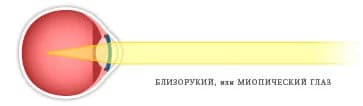
Myopia, also called nearsightedness (blurred vision of distant objects), is the most common refractive error. It usually occurs when the eye is too long or the cornea is too curved. Due to this extra length, distant objects are focused in front of the retina, causing light to scatter and the brain to receive an unfocused image. Myopia is a refractive error that prevents the eye from seeing distant objects. It can be corrected with glasses, contact lenses, or refractive surgery.
Hyperopia
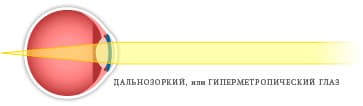
Hyperopia is the inability to see nearby objects caused by a too-short eye or a too-flat cornea. Due to insufficient eye length, the cornea and lens do not have enough space to focus light on the retinal focal point, so the image is focused behind the retina and the brain receives inaccurate signals.
Astigmatism
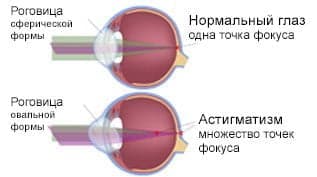
Another term for poor corneal curvature is astigmatism, which occurs when the cornea is not round but shaped like a rugby ball, preventing the eye from focusing light from any distance. Untreated astigmatism can cause strabismus and sudden vision deterioration. Without correction, astigmatism may also cause headaches and eye pain.
Presbyopia
Presbyopia is age-related hyperopia caused by natural human aging. It is a refractive anomaly in which a person cannot see small print or nearby objects clearly. This condition typically appears in people between 40 and 50 years of age. Presbyopia develops as the natural lens of the eye ages, becomes harder, and loses elasticity, usually resulting in the need for reading glasses.
Cataract
Contrary to common belief, a cataract is not a layer forming on the surface of the eye but a change in the transparency of the lens inside the eye, which prevents light rays from passing through it. Due to this gradually increasing cloudiness, vision can become less sharp over time. Light entering the retina is scattered, resulting in blurred vision.
appointment booking
Convenient booking and transparent consultation cost
We have made the process of contacting the clinic as simple as possible. You only need to book an appointment with an ophthalmologist in Vilnius online or by phone.
book a consultation
required fields